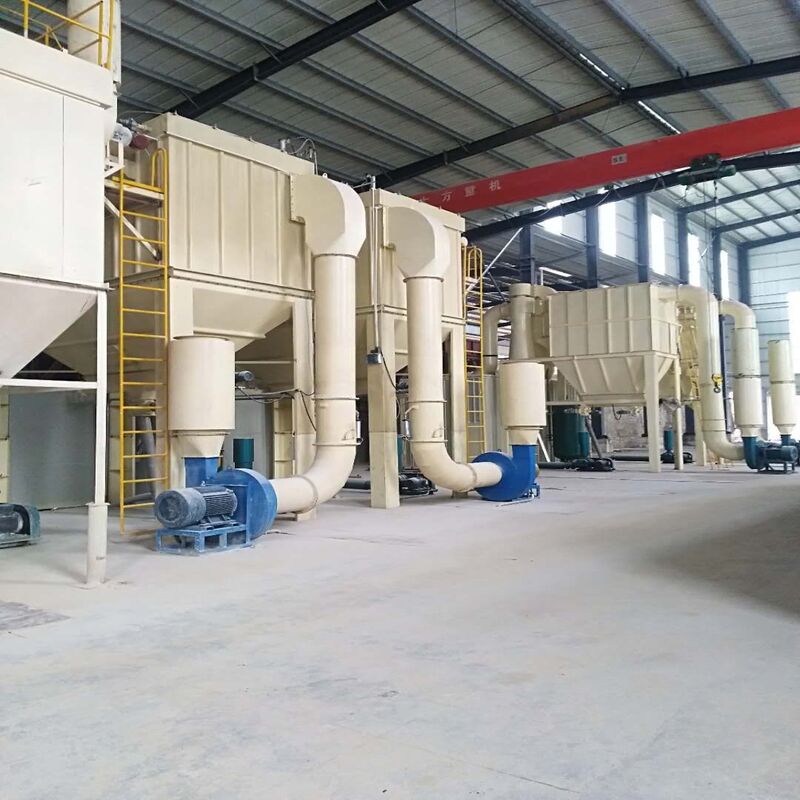
Barite grinding mill
China No.1 Technology
- Our New type: Combined grinding wheel bracket – Demonstration of assembly
- Our New – type: Rhombic Spindle
- Easy to disassemble.
- Low cost of accessories.
- Spindle nut No loosening, No thread slipping, No falling off.
- Low cost, High reliability
Barite grinding mill description:
A barite grinding mill is a specialized industrial equipment designed to process barite ore into fine powder ranging from 150 to 3000 mesh. It integrates crushing, grinding, drying, and classification in one compact unit, boasting high production efficiency, low energy consumption, and minimal dust leakage.
Driven by centrifugal force, its grinding rollers press tightly against the ring to pulverize materials, with qualified fine powder collected after classification while coarse particles are re-ground. Widely used in oil drilling weighting agents, paint, and medical industries, it features easy maintenance, high automation, and stable output from 1 to 25 t/h, making it ideal for large-scale barite powder production.
What is Barite grinding mill?
A barite grinding mill is a dedicated industrial processing machine that crushes and grides raw barite ore into fine, uniform powder with adjustable fineness from 80 to 3000 mesh.
It works by using centrifugal force to press grinding rollers tightly against the ring, repeatedly rolling and grinding materials in multiple grinding tracks. After classification, qualified fine powder is collected as finished products, while coarse particles return for regrinding.
This mill features high automation, low energy consumption, easy maintenance, and 1–25 t/h stable output. The produced barite powder is widely used in oil drilling weighting agents, coatings, medical imaging, and plastic filling industries.
What is the Barite grinding mill process?
The barite grinding mill process starts with raw barite ore being crushed by a jaw crusher to 10–20mm particles.
These qualified materials are evenly fed into the main grinding chamber, where centrifugal force presses rollers tightly against the ring to repeatedly grind the ore. Ground fine powder is carried by airflow to the classifier, with oversize particles sent back for regrinding. Qualified fine powder is collected by the dust collector, then conveyed to the finished product silo before being packaged automatically.
The whole process runs in a closed system, with adjustable fineness from 80 to 3000 mesh, ensuring stable quality and low dust leakage.
What are the uses of Barite grinding mill?
A barite grinding mill is purpose-built to process raw barite ore into fine powder with adjustable fineness from 80 to 3000 mesh, serving diverse industrial scenarios.
Its core output is 200-mesh barite powder, which accounts for 80–90% of global usage as a weighting agent for oil and gas drilling mud. It also produces high-fineness powder used as a filler in paints, plastics, rubber, and textiles, boosting product wear resistance and whiteness.
Additionally, the mill makes radiation-shielding barite powder for medical barium meals, radiation-proof cement, and glass manufacturing, delivering stable, low-dust production for non-metallic mineral processing lines.
What is the best Barite grinding mill process?
The best barite grinding mill process varies by target fineness and production scale.
For D50 >10μm drilling-grade powder, the dry grinding process is optimal, featuring low investment, simple operation, and low running cost. For 5–10μm fine powder, the dry ball mill plus air classification system balances efficiency and particle size precision.
For ultra-fine products below 3μm, the combined process of pre-coarse grinding, dry ball mill, and jet mill easily achieves D50 1.5–2.5μm. This process avoids over-grinding, cuts energy waste by 30%, and ensures stable, qualified powder for high-end chemical and pharmaceutical applications.
Barite grinding mill process Application:
The barite grinding mill process delivers tailored fine powder for diverse industrial applications.
For oil and gas drilling, it produces 200–325 mesh high-specific-gravity barite powder as weighting mud, preventing well blowouts. For paint and coating industries, it grinds 600–1250 mesh powder to enhance coating wear resistance and whiteness.
In the medical and radiation protection field, it makes high-purity fine powder for barium meals and shielding materials. The process also supports plastic, rubber, and construction sectors, providing uniform filler powder to improve product performance, with low over-grinding rate and stable quality for large-scale continuous production.